2018 Dodge Challenger SRT Demon: The Day Dodge Lit the Afterburners
Let’s get one thing straight right out of the burnout box: the Challenger SRT Demon was unveiled in 2017, but it technically hit the streets as a 2018 model-year car. Still, enthusiasts—and yes, even Dodge folks over beers—often call it “the 2017 Demon,” because that’s the year it shocked the automotive world and rewrote the muscle car rulebook. Semantics aside, this thing is exactly what happens when engineers are told “no compromises” and actually listen.
We’ve spent quality time with the Demon, both on the street and doing exactly what Dodge designed it to do: annihilate a drag strip. This isn’t just a Hellcat turned up to 11. It’s a factory-built, warranty-backed drag car that somehow still has turn signals.
Features: A Drag Car With a VIN
At the heart of the Demon is a heavily reworked version of the familiar 6.2-liter supercharged HEMI V8—but calling it “familiar” feels wrong. Dodge upgraded nearly everything that matters:
- Supercharger: 2.7-liter (up from the Hellcat’s 2.4L), pushing up to 14.5 psi
- Output:
- 808 hp / 770 lb-ft on 91-octane pump gas
- 840 hp / 770 lb-ft on 100+ octane race fuel
- Redline: 6,500 rpm
- Transmission: TorqueFlite 8HP90 8-speed automatic, beefed up for abuse
- Driveline: Reinforced driveshaft, upgraded differential, stronger half-shafts
Dodge didn’t stop at raw horsepower. The Demon introduced a suite of firsts for a production car:
- Factory TransBrake (activated via paddle shifters)
- Torque Reserve, which preloads the driveline and supercharger at launch
- After-Run Chiller, using the A/C system to cool the intercooler after shutdown
- Power Chiller, redirecting A/C cooling to the intake charge under load
The result? Dodge-certified numbers that still sound fake years later:
- 0–60 mph: 2.3 seconds
- Quarter-mile: 9.65 seconds @ 140 mph (on race fuel)
Yes, it literally lifts the front wheels. Dodge even supplied the NHRA paperwork to certify it as the world’s first production car capable of a wheelie.
Styling: Function Over Flash (But Still Mean)
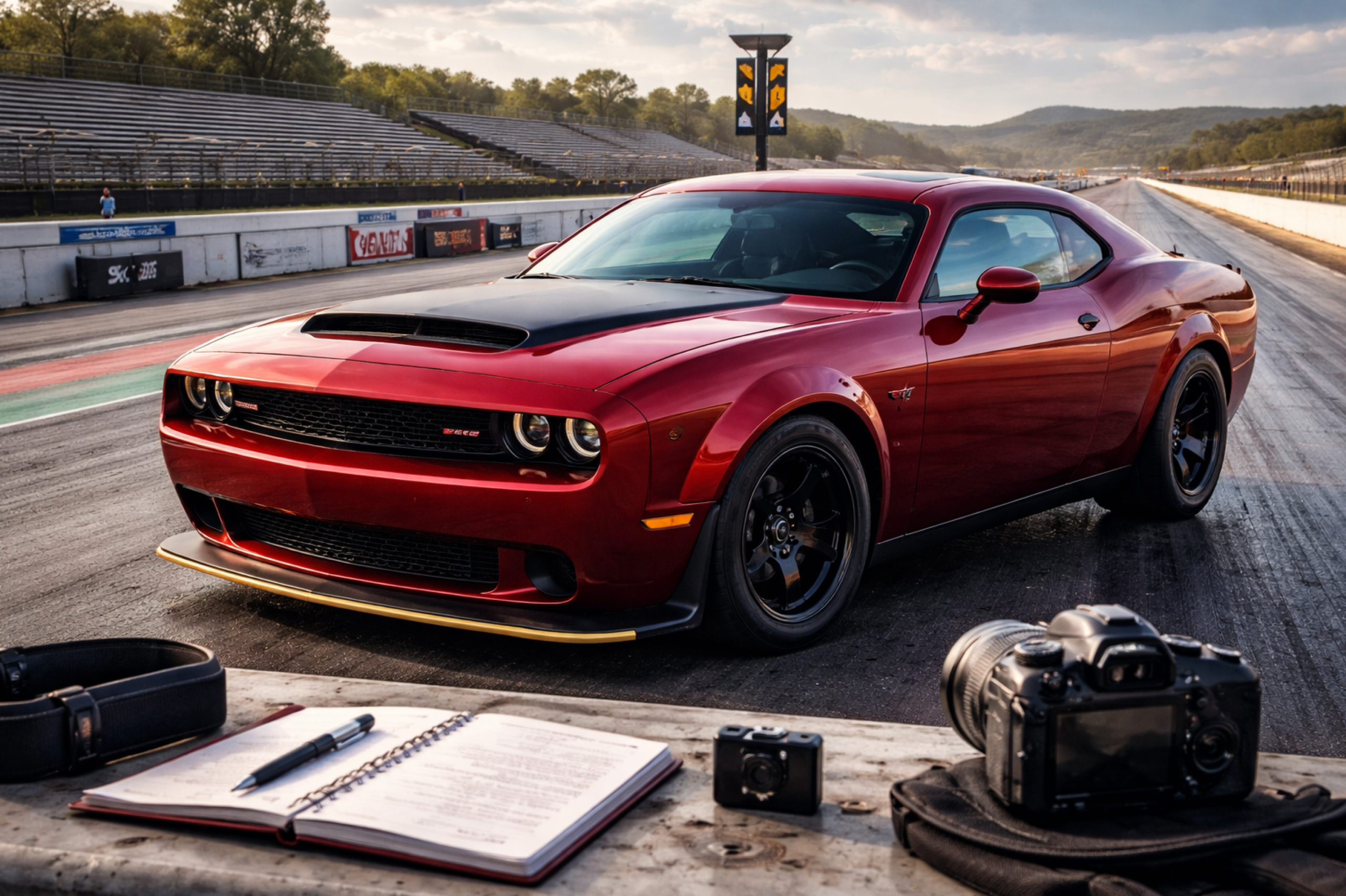
Visually, the Demon takes the Challenger widebody look and turns the aggression dial all the way clockwise. The most obvious feature is the Air-Grabber hood, crowned with the largest functional hood scoop ever fitted to a production car. At wide-open throttle, it feeds cooler, denser air directly into the supercharger—up to 173 cubic feet per minute more than a Hellcat.
Other standout design cues include:
- Widebody fender flares, accommodating massive rubber
- Lightweight 18×11-inch wheels at all four corners
- 315/40R18 Nitto NT05R drag radials, factory-installed and street-legal (barely)
- Demon-specific badging, including the now-iconic snarling devil emblem
Dodge also obsessed over weight savings. Depending on how you spec it, the Demon can shed more than 200 pounds compared to a Hellcat:
- Rear seat delete (standard)
- Front passenger seat delete (no-cost option)
- Trunk carpeting delete
- Minimal sound deadening
Air conditioning and the 8.4-inch Uconnect infotainment system were optional—and cost exactly one dollar each. That’s not a typo. Dodge wanted owners to choose comfort.
Performance: Built to Do One Thing—Perfectly
On the street, the Demon is surprisingly civilized—until you dip into the throttle. Below that, it idles with a cammy lope, the supercharger whining like it’s impatient. But let’s be honest: this car lives for the drag strip.
Engage Drag Mode, heat the rear tires, activate the TransBrake, and the Demon becomes a physics experiment. Launches are violent but controlled, thanks to drag-specific suspension tuning, adaptive Bilstein dampers, and that massive tire footprint.
The steering feels lighter than a Hellcat’s, partly due to the skinny front runners included in the Demon Crate (more on that in a second). Braking is handled by Brembo hardware that’s more than adequate—though repeated hard stops will remind you this is not a road-course toy.
Ownership: Extreme, But Thoughtfully So
Dodge limited production to 3,300 units total:
- 3,000 for the U.S.
- 300 for Canada
Every Demon came with a serialized build plaque, and every owner received the now-legendary Demon Crate, a factory-included, Dodge-licensed kit containing:
- Skinny front wheels with tires (for drag racing)
- High-performance jack
- Cordless impact wrench
- Torque wrench
- Tire pressure gauge
- Laptop mount and ECU unlock cables
- Performance control module for race fuel
Living with a Demon requires a bit of commitment. Those Nitto drag radials wear quickly, don’t love cold weather, and will happily hydroplane if you’re careless. Insurance companies know exactly what this car is. Maintenance is Hellcat-adjacent, but consumables—tires especially—add up fast.
That said, Dodge didn’t abandon owners after delivery.
Dodge-Licensed Post-Sale Components
Through Mopar and Direct Connection, Dodge has continued to support Demon owners with factory-backed performance and restoration parts, including:
- Direct Connection engine components (superchargers, internals, controllers)
- Drag Pack wheels and accessories
- Replacement Demon-specific body panels and graphics
- Serialized Demon Crate replacement items
- Harness Bar and Harness Belts through licensed vendor Speedlogix
- Performance calibration tools and race-oriented hardware
This matters, because it keeps the Demon in a rare category: a modern collectible that can still be serviced, raced, and restored using factory-authorized parts.
Final Thoughts: A Muscle Car Mic Drop
The Challenger SRT Demon wasn’t built to chase Nürburgring lap times or win comparison tests. It was built to dominate one very specific arena—and it did so with unapologetic excess and engineering brilliance.
From its outrageous factory specs to its drag-strip-first design philosophy, the Demon represents a high-water mark for internal combustion muscle. Dodge didn’t just build a fast car. They built a statement, handed you the keys, and said, “Go prove it.”
Years later, the Demon still feels unrepeatable. And honestly? That’s exactly how legends are supposed to feel.